Digital Water Flow Measurement System
Measure the Flow. Report It With Confidence.
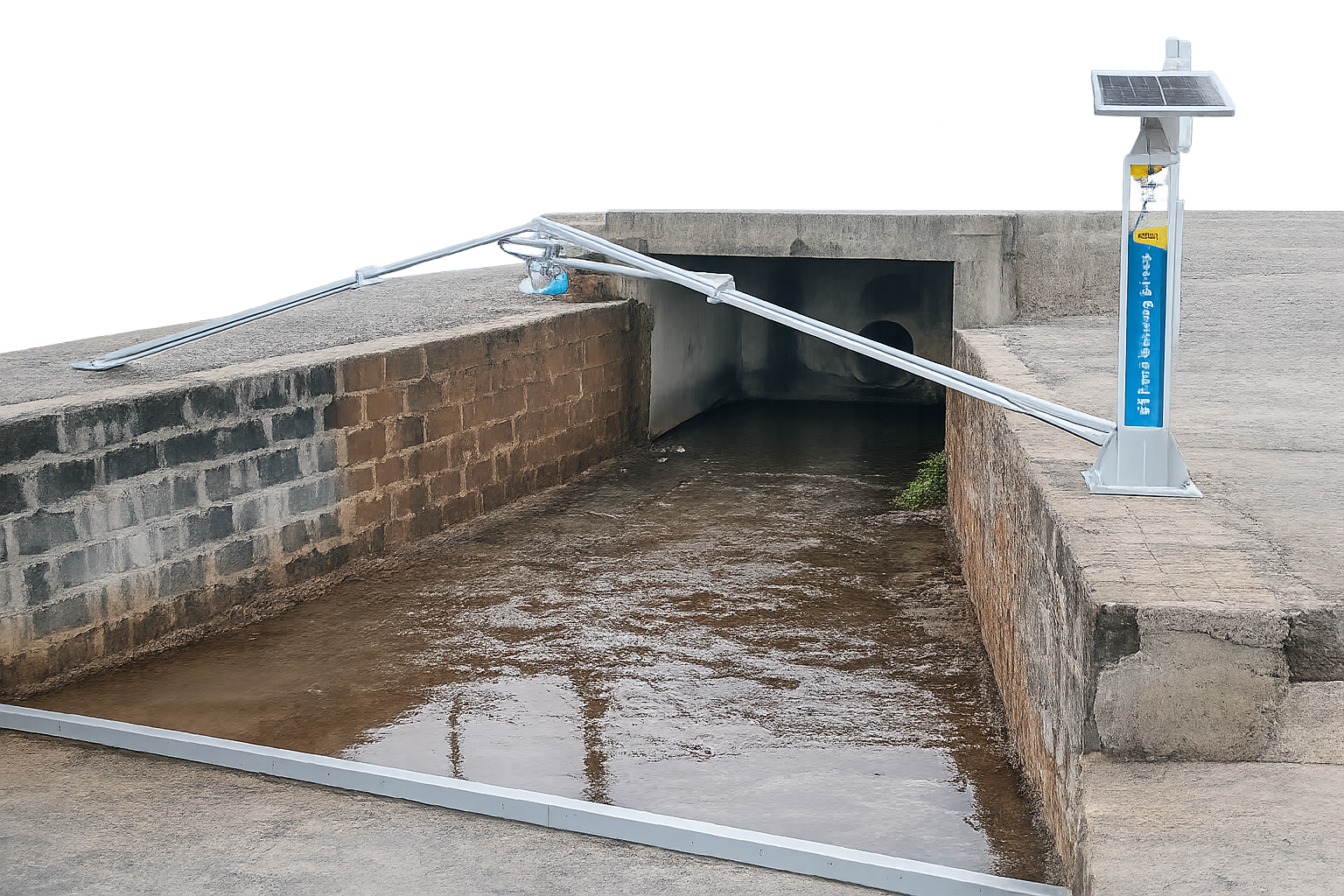
Site & Reporting Architecture
Configure It Around Your Site and Your Reporting
A treatment plant outlet and an irrigation channel rarely need the same setup, and a listed manufacturer reports very differently from a municipal water body. So the hardware is configured around the monitoring point, and the reporting is configured around what you actually have to disclose.
Notch Geometry
Engineered to match channel cross-section and flow range.
Power Source
Flexible options for remote channels or grid installations.
Connectivity
Direct cloud telemetry and industrial automation output.
Reporting Modules
Automated disclosures for sustainability and regulators.
Tailor-Made Hydraulic & Reporting Package
Whether you monitor a 50 KLD treated effluent weir at an STP outlet or a high-discharge municipal flood drain, our engineering team manufactures the exact weir blade (SS304/SS316) and programs the empirical flow formulas to match your channel.
Core Capabilities
Key Features
Designed for complete open-channel data integrity, low maintenance, and seamless audit trace from weir level to board room.
Audit-Ready Data Trail
Every reading is timestamped and stored, both on the device and in the cloud. Any figure that appears in a report can be traced straight back to the meter it came from and the moment it was recorded, which is the first thing an auditor or assurance provider will want to see.
ESG-Ready Water Reports
Daily consumption, monthly totals and water balance reports are built from live meter data, not from logbooks typed into a spreadsheet at year-end. Your team can use them directly for ESG disclosures, water-neutrality plans and green-building documentation.
Discharge You Can Account For
Open channels are usually where treated water, effluent and storm outflow leave a site. Measuring them closes the gap in your water balance between what comes in and what goes out, a gap that is otherwise filled with estimates.
Non-Contact Ultrasonic Sensing
The sensor takes its reading from above the water, so there are no moving sensing parts in the flow. That keeps maintenance low, avoids debris fouling or corrosion from aggressive effluent, and maintains a steady data stream.
Remote Monitoring
The 3G/4G RTU sends data to the cloud dashboard, where hourly, daily and monthly figures can be reviewed from a mobile or PC. Device status is visible too, so a gap in the data gets noticed in days, not when the annual report is due.
Ready for Plant Automation
RS-485 Modbus RTU output lets the system connect directly with SCADA and plant automation systems, ensuring operations and sustainability teams work continuously from the exact same numbers.
Solar or Grid Powered
Choose solar power with battery backup for remote discharge channels and irrigation drains, or a standard 230V AC configuration where reliable grid power supply is available inside plant premises.
Factory Calibrated
Each system is calibrated using controlled flow tests and established empirical hydraulic formulas, with a stated accuracy of ±2–5% of actual flow. A calibrated instrument is the starting point for any number you intend to put in a disclosure.
Engineering Data
Technical Specifications
Engineering teams need the numbers up front, and so do the people who will later sign off on the data. Here are the core specifications.
| Specification | Details |
|---|---|
| Measurement principle | Weir flow measurement |
| Notch geometry | 90° V-notch; alternative geometries available (Trapezoidal, Rectangular, Half-Circular) |
| Base plate | Mild steel with anti-corrosion treatment |
| Weir blade | SS304 / SS316 stainless steel |
| Sensor | Non-contact ultrasonic level sensor |
| Accuracy | ±2–5% of actual flow |
| Output | RS-485 Modbus RTU |
| Communication | 3G/4G IoT RTU |
| Power | Solar + battery backup / 230V AC grid |
| Data logging | Timestamped readings, stored locally and in the cloud |
| Reports | Daily consumption, monthly totals, water balance, ESG-ready summaries |
| Operating temperature | -10°C to +60°C |
| Protection | IP65 sensor and RTU enclosure |
Commercial & Engineering Actions
Media Gallery
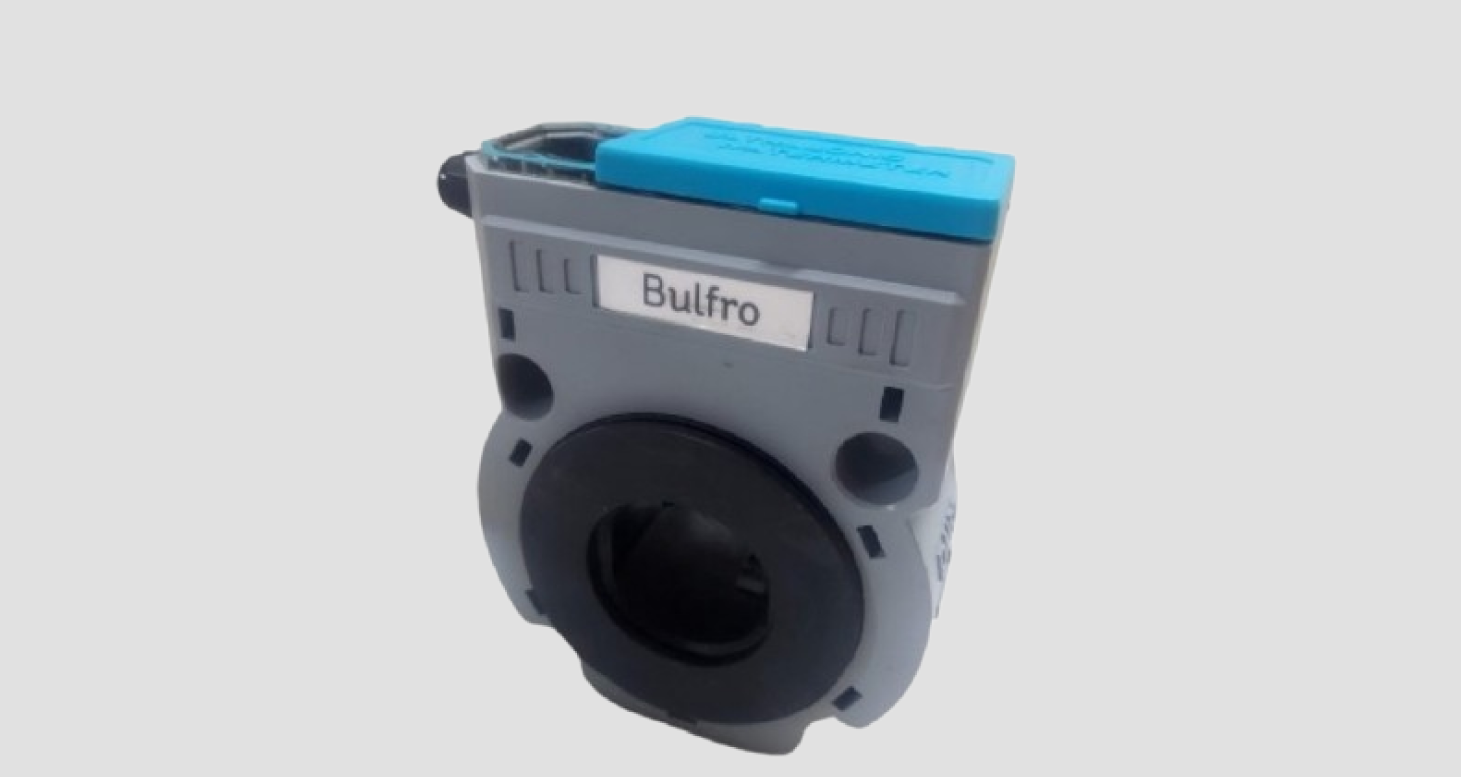
Hardware & Flow Transducers
ESG & Regulatory Compliance
From Flow Reading to ESG Disclosure
Water disclosure questions sound simple. How much did you withdraw? How much did you discharge, and where did it go? How do you know? When the figures come from manual logbooks, that last question is the hardest one to answer. With continuous metering, it becomes the easiest.
Here is how the flow data supports the reporting most Indian industrial sites deal with:
| What you need to report | How the system supports it |
|---|---|
|
Water discharge volumes
GRI 303-4
|
Continuous measurement at STP/ETP outlets and effluent channels, totalised daily and monthly. |
|
Water consumption and water balance
GRI 303-5
|
Discharge data sits alongside borewell and pipe-meter data in one site water balance. |
|
BRSR Principle 6 water disclosures
SEBI BRSR
|
Withdrawal, consumption and discharge figures backed by metered, timestamped data. |
|
CGWA NOC compliance records
CGWA NOC
|
Timestamped readings that can be pulled for any period when the authority asks. |
|
Water footprint studies
ISO 14046
|
Measured, not estimated, volumes on the outflow side of the footprint. |
|
Water-neutrality and green-building documentation
IGBC / LEED
|
Water balance and harvesting data reported from the same dashboard. |
Integrated Into the Whole-Site Water Ecosystem
The flow meter doesn’t work on its own. It plugs into the Bulfro Aqua ESG Water Management System, together with Digital Water Level Recorders, electromagnetic and ultrasonic pipe flow meters, and rainwater harvesting monitoring. The plant layout view maps every flow meter, borewell and tank on a single screen, so your reports reflect the whole site and not just one channel. Where needed, the same readings also go into SCADA through RS-485 Modbus RTU.
Field Implementation
See Open-Channel Metering in Action
Watch how the weir notch and ultrasonic sensing assembly operate continuously in industrial effluent and discharge channels.
Field Applications
Applications Across Industry & Infrastructure
From compliance-mandated discharge channels to large-scale municipal irrigation, DWFMS provides continuous precision.
ETP & STP Discharge Monitoring
Continuous outflow tracking at treated effluent plants for ESG disclosures, state pollution board compliance, and CGWA submissions.
Site Water Balance & Neutrality
Reconciles exact outflow against input volumes to eliminate manual estimation gaps in water-neutrality programmes.
Industrial Water Management
Real-time open channel flow accounting across manufacturing complexes, chemical processing plants, and food & beverage facilities.
STP & WTP Inlet/Outlet Measurement
Comparative flow tracking between raw intake and treated effluent channels to evaluate plant operational treatment efficiency.
Irrigation Channels & Distribution
Accurate volumetric accounting for canal networks, agricultural irrigation canals, and gravity-fed water conveyance ducts.
Smart City Water Monitoring
Telemetry-connected open stormwater and wastewater canal monitoring integrated directly into centralized city operations centers.
Reservoir & Dam Flow Monitoring
High-reliability weir and spillway flow measurement for reservoirs, holding ponds, barrages, and municipal water storage.
Environmental Flow Studies
Long-term continuous streamflow baseline data recording for ecological impact assessments and ISO 14046 water footprint studies.
End-to-End Partnership
Support Beyond the Instrument
A flow meter only earns its place in an ESG report if the data keeps coming in, month after month, without gaps.
Bulfro Aqua ESG supports the system with professional on-site installation, data management and security, annual maintenance contracts (AMC), CGWA NOC compliance and ESG water audit support, and seamless IoT integration with the rest of your water monitoring.
Bulfro Aqua ESG is a Pune-based company incubated at SINE, IIT Bombay. Over 146 clients, including Amul, Asian Paints, Cipla, Danfoss and Emerson, rely on our monitoring, and more than 17.5 billion litres of water have been measured across our installations. For industrial teams in Pune and across Maharashtra, that means a local point of contact for product discussions, site visits and support.
Common Questions
Frequently Asked Questions
Find clear answers regarding notch geometry, measurement principles, ESG audit compatibility, SCADA connectivity, and accuracy.
A notch or weir is installed in the channel, and a non-contact ultrasonic sensor above it measures the water level. The level is converted to flow using calibrated weir equations, and the readings are logged and sent to the cloud.
Yes. Every reading is timestamped and stored locally and in the cloud, and every figure in a report comes straight from a meter with the date and time attached. Final assurance is always your auditor’s call, but they will be working from metered data rather than estimates.
The flow data supports water discharge and water balance figures commonly reported under GRI 303, BRSR Principle 6, CGWA NOC requirements, ISO 14046 water footprint studies and green-building documentation.
Yes. It is part of the Bulfro Aqua ESG Water Management System, so open-channel flow, pipe flow meters, groundwater level recorders and rainwater harvesting data can all be viewed and reported together.
V-notch, rectangular, trapezoidal and half-circular designs are available. The notch is designed around the required flow range and the space at the site.
Yes. The 3G/4G RTU sends data to a cloud dashboard that can be accessed from a mobile or PC.
Yes. It provides RS-485 Modbus RTU output for SCADA and plant automation integration.
The system is factory calibrated, and the product brochure specifies an accuracy of ±2–5% of actual flow.
Yes. The system can run on solar power with battery backup, or on 230V AC grid supply.
Let’s Make Your Water Numbers Audit-Ready
Tell us about your channel, the expected flow range, the power available at site and the reporting you need to deliver, whether that’s a CGWA submission, a BRSR disclosure or an internal water-neutrality target. We’ll suggest a setup that fits both the site and the report.